Wheel Nut Torque Chart PDF: A Comprehensive Guide
Navigating wheel maintenance requires precision, and a wheel nut torque chart PDF is essential. These charts detail proper tightening specifications,
ensuring vehicle safety and preventing wheel detachment.
Understanding the Importance of Correct Torque
Achieving the correct wheel nut torque is paramount for vehicle safety and longevity. Under-torquing can lead to wheel loosening during operation, a catastrophic failure risk, while over-torquing stretches studs and potentially damages wheels, creating stress fractures. A wheel nut torque chart PDF provides the precise specifications needed to avoid these dangers.
Proper torque ensures even clamping force across the wheel, maintaining a secure connection between the wheel, hub, and brake rotor. This prevents vibrations, uneven wear on braking components, and potential warping of the rotor. Utilizing a torque wrench, guided by a reliable chart, guarantees consistent and accurate tightening.
Furthermore, correct torque is crucial for wheel stud health. Consistent application within specified limits extends stud life, reducing the need for frequent replacements. Ignoring torque specifications can compromise the integrity of the entire wheel assembly, impacting handling and overall vehicle performance. Always consult a wheel nut torque chart PDF specific to your vehicle and wheel type.
What is Wheel Nut Torque?
Wheel nut torque refers to the rotational force applied to tighten the lug nuts securing a wheel to a vehicle’s hub. It’s not simply about how “tight” a nut feels, but a precise measurement expressed in foot-pounds (ft-lbs) or Newton-meters (Nm). A wheel nut torque chart PDF details these specific values for various vehicle makes, models, and wheel types.
Essentially, torque dictates the clamping force – the pressure exerted by the wheel against the hub. This force is critical for maintaining a secure connection, preventing wheel wobble, and ensuring safe driving conditions. Different stud sizes (1/2″, 9/16″, 5/8″) and lug nut styles (coned, flanged) require different torque specifications, as outlined in these charts.
Understanding that torque is a twisting force, applied at a 90-degree angle, is key. A torque wrench measures this force, allowing technicians and DIYers to achieve the manufacturer’s recommended tightness. Always refer to a wheel nut torque chart PDF to avoid under or over-tightening, safeguarding both the wheel and the vehicle.
Why Use a Wheel Nut Torque Chart?
Employing a wheel nut torque chart PDF is paramount for vehicle safety and longevity. Incorrect torque – whether too loose or too tight – can lead to severe consequences. Under-tightening risks wheel detachment while driving, a catastrophic scenario. Over-tightening can stretch or break wheel studs, damage brake rotors, and warp wheel hubs, leading to costly repairs.
These charts provide manufacturer-specified values, accounting for variations in stud size (like 1/2″, 9/16″, 5/8″), lug nut type (coned, flanged), and wheel material (steel, alloy). A chart ensures consistent and accurate tightening across all wheel nuts, distributing clamping force evenly.
Furthermore, a wheel nut torque chart PDF simplifies the process, eliminating guesswork. It’s a readily accessible resource for both professional mechanics and vehicle owners performing DIY maintenance. Utilizing these charts demonstrates a commitment to responsible vehicle ownership and prioritizes passenger safety on the road.
Factors Affecting Wheel Nut Torque Specifications

Several critical factors influence the correct wheel nut torque specifications, necessitating the use of a precise wheel nut torque chart PDF. Stud size – 1/2″, 9/16″, or 5/8″ – directly correlates with required torque; larger studs demand higher values. Lug nut type also plays a role; flanged nuts, especially those with rotating or non-rotating features, have unique requirements.
Wheel material is another key consideration. Steel wheels generally require different torque than alloy wheels due to variations in material strength and heat dissipation. The presence of a wheel clamp ring, often seen on commercial vehicles, significantly increases torque needs (190-210 ft-lbs).
Lubrication of the stud threads impacts torque. Charts often specify values for dry or lubricated threads; lubricated threads require reduced torque to achieve the same clamping force. Always consult the chart and adhere to the specified conditions for accurate tightening and optimal wheel security.
Stud Size and Torque Relationship
A direct correlation exists between stud size and the appropriate wheel nut torque, clearly outlined in any comprehensive wheel nut torque chart PDF; Smaller stud diameters, such as 1/2″, typically require lower torque values – generally around 90-120 ft-lbs for coned lug nuts on steel wheels.
As stud diameter increases to 9/16″, the necessary torque rises, commonly to 120-140 ft-lbs for similar configurations. The largest commonly used size, 5/8″, demands significantly higher torque, often ranging from 190-210 ft-lbs, particularly when used with wheel clamp rings on heavier-duty applications.
This relationship is fundamental because larger studs possess greater tensile strength and can withstand higher clamping forces. Utilizing the correct torque for each stud size ensures adequate wheel retention without risking stud damage or wheel loosening. Always refer to a reliable chart for precise specifications.
Lug Nut Types and Their Impact on Torque
Different lug nut designs necessitate varying torque specifications, as detailed in a wheel nut torque chart PDF. Coned lug nuts, commonly found on steel wheels, generally require torque values between 90-140 ft-lbs, depending on stud size.
Flanged lug nuts, particularly those with a non-rotating flange, often demand higher torque – crucial for maintaining clamping force. Those utilizing wheel clamp rings, typically 5/8″ studs, can require 190-210 ft-lbs. The presence of a wheel clamp ring significantly increases the required torque.
It’s vital to identify the lug nut type before tightening. Incorrect torque application can lead to wheel loosening or, conversely, stud damage. Always consult a reliable chart specifying torque values based on both stud size and lug nut style for optimal safety and performance.

Wheel Material and Torque Values
Wheel material significantly influences appropriate torque specifications, as outlined in a comprehensive wheel nut torque chart PDF. Steel wheels, known for their durability, typically accommodate a broader torque range, often falling between 90-140 ft-lbs for common stud sizes like 1/2″ and 9/16″.
Alloy wheels, while lighter, often require more precise torque control. While specific values vary, it’s crucial to adhere to the manufacturer’s recommendations found in the chart. Over-tightening can damage the alloy, while under-tightening risks wheel separation.
The wheel’s construction and load rating also play a role. Heavier-duty wheels, like those used in commercial applications, will generally necessitate higher torque values. Always prioritize the torque specifications detailed in a reliable chart, considering both material and wheel size, to ensure safe and secure wheel attachment.
Torque Specifications for Common Stud Sizes (1/2″, 9/16″, 5/8″)
A wheel nut torque chart PDF will typically categorize specifications by stud size. For 1/2″ studs, a common torque range is 90-120 ft-lbs, often used with coned lug nuts on 16” steel wheels. 9/16″ studs generally require 120-140 ft-lbs, also frequently paired with coned nuts and steel wheels.
Larger 5/8″ studs demand significantly higher torque. Standard coned nuts with a wheel clamp ring can range from 190-210 ft-lbs, particularly on 17.5” single or 16” dual steel wheels. Flanged nuts, often non-rotating, also utilize 5/8” studs, requiring precise tightening.
It’s vital to consult a chart for specific applications, as variations exist. Remember that these are general guidelines; always prioritize the manufacturer’s recommended torque for your vehicle and wheel combination, as detailed in a reliable wheel nut torque chart PDF.
Torque Charts for Steel Wheels
Wheel nut torque chart PDFs dedicated to steel wheels often present specifications based on stud size and wheel diameter. For 16” steel wheels, common torque values range from 90-140 ft-lbs, depending on whether 1/2” or 9/16” studs are used, and the lug nut type (coned or flanged). Larger 17.5” and 19.5” steel wheels, frequently found on commercial vehicles, necessitate higher torque.
Specifically, 17.5” single steel wheels with 5/8” studs and wheel clamp rings typically require 190-210 ft-lbs. It’s crucial to differentiate between rotating and non-rotating flange nuts when referencing a wheel nut torque chart PDF, as they have differing torque requirements.

Always prioritize charts that specify torque for greased threads, as this impacts the final tightening value. Consistent application of the three-stage torque process, detailed in most comprehensive PDFs, is essential for steel wheel safety and longevity.
Torque Charts for Alloy Wheels
Wheel nut torque chart PDFs for alloy wheels often emphasize the importance of precise tightening due to the material’s sensitivity. While specific values vary significantly by vehicle make and model, a common range for alloy wheels with 1/2” or 9/16” studs falls between 80-100 ft-lbs. However, this is a generalization; always consult a chart specific to your vehicle.
Unlike steel wheels, alloy wheel torque specifications are less frequently dictated by wheel diameter and more by the vehicle manufacturer’s recommendations. Wheel nut torque chart PDFs will often categorize specifications by vehicle year, model, and wheel size.
It’s vital to avoid over-tightening alloy wheels, as this can lead to stud damage or wheel distortion. The three-stage torque process, outlined in detailed PDFs, is particularly crucial for alloy wheels to ensure even pressure distribution and prevent cracking.
The Three-Stage Torque Process
Wheel nut torque chart PDFs consistently advocate for a three-stage tightening process, ensuring even clamping force and preventing wheel distortion. The first stage involves hand-tightening all lug nuts, establishing initial contact between the wheel and the hub. PDF guides specify a low torque value, typically around 20-25 ft-lbs, for this initial pass.
The second stage, intermediate tightening, utilizes a torque wrench set to approximately 50-75 ft-lbs. This stage focuses on drawing the wheel evenly against the hub, again following a star or crisscross pattern. Wheel nut torque chart PDFs emphasize the importance of this step for proper alignment.
Finally, the third stage involves applying the final, specified torque value detailed in the PDF chart. This ensures the lug nuts are securely fastened to the manufacturer’s recommendations, preventing loosening during operation. Accurate torque application is paramount for safety.

First Stage Torque: Initial Tightening
According to numerous wheel nut torque chart PDFs, the initial tightening stage is crucial for establishing uniform contact between the wheel and the vehicle’s hub. This phase doesn’t focus on achieving full torque, but rather on ensuring all lug nuts are snug against the mounting surface. PDF resources recommend hand-tightening, or using a torque wrench set to a very low specification – generally between 20 and 25 ft-lbs.
This initial pass prevents uneven pressure distribution that could warp the wheel or damage the stud threads. Wheel nut torque chart PDFs consistently highlight the importance of a star or crisscross tightening pattern during this stage. This ensures each lug nut receives equal attention, minimizing the risk of misalignment.
It’s a preparatory step, setting the foundation for accurate torque application in subsequent stages, as detailed in the PDF guides.
Second Stage Torque: Intermediate Tightening
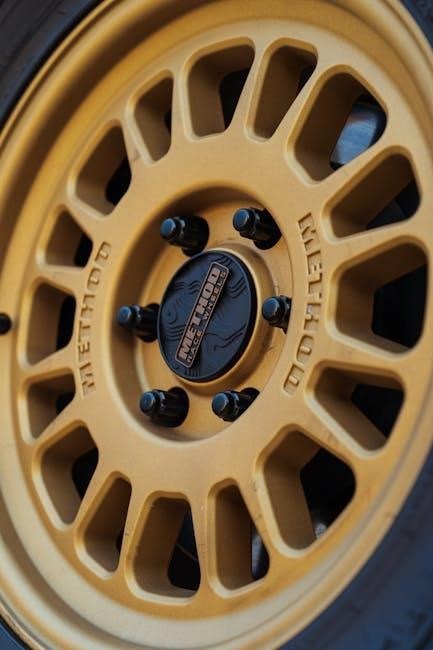
Following the initial snugging, the intermediate tightening stage, as outlined in most wheel nut torque chart PDFs, aims to bring the lug nuts closer to their final specified torque. PDF resources indicate a torque range of 35-40 ft-lbs is typical for this stage, though it varies based on stud size and wheel material. Again, maintaining the crisscross tightening pattern is paramount for even distribution of force.
This stage isn’t about achieving the final torque value; instead, it’s a progressive step, building upon the initial contact established. Wheel nut torque chart PDFs emphasize that this stage helps seat the wheel properly and identify any potential issues, like cross-threading, before full torque is applied.
Carefully re-check each lug nut after this pass, ensuring they are all tightened consistently, preparing for the final torque application detailed in the PDF guides.
Third Stage Torque: Final Torque Application
The final stage, detailed in any comprehensive wheel nut torque chart PDF, involves applying the manufacturer’s specified torque value. PDF resources show values ranging from 90-210 ft-lbs, depending on stud size (1/2″, 9/16″, 5/8″) and wheel type. Crucially, the crisscross pattern must be maintained throughout this final tightening process to guarantee uniform clamping force.

Referencing your specific wheel nut torque chart PDF is vital; over-tightening can stretch studs and damage wheels, while under-tightening risks wheel detachment. PDF guides often highlight the importance of using a calibrated torque wrench for accuracy.
After completing this stage, a final visual inspection and re-check of each lug nut, using the torque wrench, is recommended to confirm proper tightening, as indicated in the PDF instructions. This ensures optimal safety and performance.
Using a Torque Wrench Correctly
A calibrated torque wrench is paramount, as emphasized in every wheel nut torque chart PDF. First, set the wrench to the precise torque specification found in your PDF chart – values vary significantly based on stud size and wheel material. Ensure the wrench is in the correct unit (ft-lbs or Nm).
When applying torque, pull smoothly and steadily on the wrench handle. Avoid jerking or using extensions, as these can alter the reading. PDF guides consistently advise a slow, controlled pull until the wrench clicks or indicates the target torque is reached.
Regularly calibrate your torque wrench to maintain accuracy, as detailed in some wheel nut torque chart PDF resources. Remember, relying on “feel” is insufficient; precise torque application, guided by the PDF and a functioning wrench, is crucial for safety.
Crisscross Tightening Pattern for Even Distribution
Every reliable wheel nut torque chart PDF stresses the importance of a crisscross tightening pattern. This method ensures even pressure distribution across the wheel hub, preventing warping and potential loosening. For five-lug wheels, a star pattern (1-3-5-2-4) is recommended, while six-lug wheels utilize a pattern like 1-4-2-5-3-6.
PDF guides illustrate this sequence visually, emphasizing the need to tighten nuts in opposing pairs. Begin with snugging all nuts by hand, then proceed with the three-stage torque process – initial, intermediate, and final – following the crisscross pattern each time.
Consistent application of this pattern, as detailed in your wheel nut torque chart PDF, minimizes the risk of wheel imbalance and ensures a secure connection. Ignoring this step can lead to vibration, stud damage, and, in severe cases, wheel detachment.
Where to Find Reliable Wheel Nut Torque Charts (PDF Resources)
Locating accurate wheel nut torque chart PDF resources is crucial for safe vehicle maintenance. Many vehicle manufacturers provide specific charts in their owner’s manuals or on their official websites. Felling Trailers, for example, offers comprehensive suspension fastener torque values, including wheel nut specifications, accessible online.
Additionally, reputable automotive parts retailers often host downloadable PDF charts categorized by vehicle make and model. Websites specializing in automotive repair, like those offering service manuals, are also valuable sources. Always prioritize charts from trusted sources to ensure accuracy.
Beware of generic charts, as torque specifications vary significantly based on stud size, lug nut type, wheel material, and vehicle application. Cross-reference information from multiple sources and, when in doubt, consult a professional mechanic. Reliable PDFs will clearly state the vehicle and wheel specifics they cover.